
If you run a limited company, working out corporation tax in UK is one of those jobs that never quite goes away. Rates, thresholds and reliefs shift from year to year, and getting a figure wrong can mean an unexpected bill from HMRC. This guide breaks down exactly what you’ll pay for the 2026/27 tax year, how marginal relief works, and when your return is due. At Top Bookkeeping Services, we prepare and file company tax returns every week, so this guide reflects the questions we’re actually asked by directors.
Quick Answer: What’s the Rate?
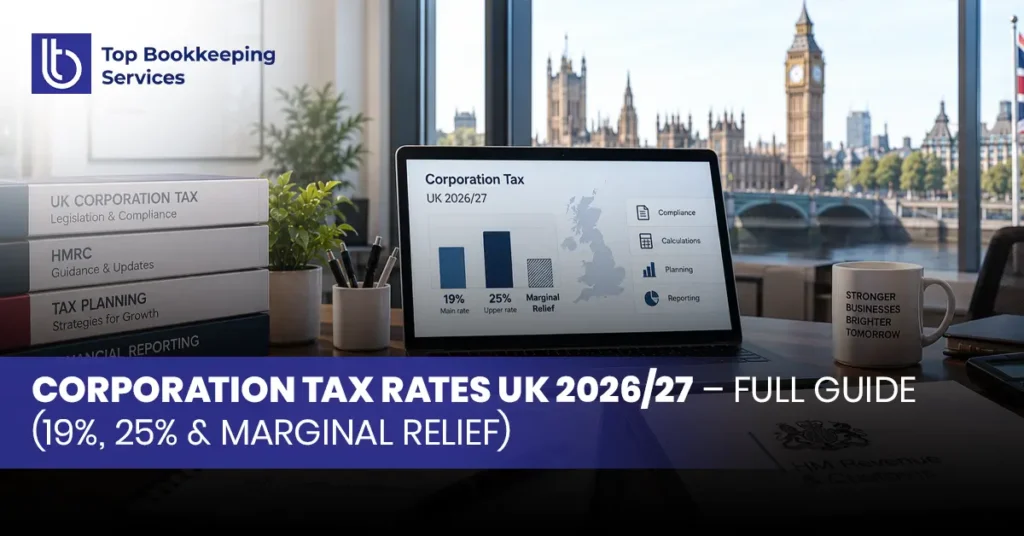
For 2026/27, corporation tax in UK still runs on the three-tier system introduced in April 2023:
- 19% small profits rate for profits up to £50,000
- 25% main rate for profits above £250,000
- Marginal relief is a sliding scale for profits between the two thresholds.
These figures haven’t changed since 2023, but the rules around associated companies, short accounting periods and filing penalties are easy to get wrong, so it’s worth reading on.
What is corporation tax in UK?
Corporation tax is the tax a limited company pays on its taxable profits; trading profits, investment income and chargeable gains all count. Unlike income tax, there’s no personal allowance; every pound of profit is taxable once reliefs and allowances have been applied. Understanding corporation tax in UK matters because, unlike PAYE, nobody deducts it automatically. Your company calculates its own liability, reports it on a CT600, and pays HMRC directly.
Sole traders and partnerships don’t pay this tax; they pay income tax instead. Only limited companies, and some clubs and associations, fall under the corporation tax regime.
The scope of corporation tax in UK also extends to non-UK resident companies with a permanent establishment in Britain, and to property income earned by companies letting UK land or buildings. Even a dormant company with no trading activity generally still has to notify HMRC and, in most cases, submit a nil return confirming there’s nothing to pay.
Corporation Tax Rates UK 2026/27
Here’s the full breakdown of Corporation Tax rates UK businesses need to plan around this year:
| Taxable Profit Band | Rate Applied | Effective Rate |
| Up to £50,000 | Small profits rate | 19% |
| £50,001 – £250,000 | Main rate less marginal relief | 19% – 26.5% (tapered) |
| Over £250,000 | Main rate | 25% |
A quirk worth flagging: profits inside the marginal band can actually attract a higher effective rate up to 26.5% than profits above £250,000. That’s because marginal relief gradually withdraws the benefit of the 19% rate as your profits climb, rather than applying a flat percentage.
How Marginal Relief Works
Marginal relief exists so companies don’t jump straight from 19% to 25% the moment they cross £50,000 in profit. Instead, tax is calculated at the full 25% main rate first, then reduced using this formula:
Marginal Relief = (Upper Limit − Taxable Profit) × (Net Profit ÷ Taxable Profit) × 3/200
The 3/200 fraction has stayed the same for 2026/27. The £50,000 and £250,000 thresholds are also divided between any “associated companies” under common control so two related companies each see their bands halved to £25,000 and £125,000.
Worked Example: Corporation Tax 2026/27 in Practice
Say a company has taxable profits of £150,000 for the year:
- Tax at the 25% main rate: £150,000 × 25% = £37,500
- Marginal relief: (£250,000 − £150,000) × 1 × 3/200 = £1,500
- Final bill: £37,500 − £1,500 = £36,000
That works out to an effective rate of 24%, sitting between the 19% and 25% bookends, exactly what marginal relief is designed to do for Corporation Tax 2026/27.
It’s worth running this calculation before your year-end rather than after it. If a company is sitting close to £250,000 in taxable profits, bringing forward a piece of allowable capital expenditure, or delaying a chargeable disposal into the next accounting period, can shift the whole marginal relief calculation and meaningfully change the final bill.
Directors moving from sole trader status to a limited company are often surprised by how differently corporation tax in UK is administered compared with self-assessment. There’s no single annual deadline to remember; payment and filing dates run independently, and both are calculated from your company’s own accounting period rather than a fixed date in the calendar.
How to File Corporation Tax
Every company must submit a CT600 return, even if it made a loss or is dormant. To file corporation tax correctly, you’ll need:
- Full statutory accounts prepared under UK GAAP or IFRS
- A CT600 form, either through HMRC’s own software or third-party accounting tools
- Supporting computations showing how taxable profit was derived from accounting profit
- Any claims for reliefs, such as R&D relief or capital allowances, included in the return
Most companies use accounting software or an accountant to file corporation tax, since the computations behind the CT600 are rarely straightforward once allowances and adjustments come into play.
Key Deadlines for Corporate Taxation UK
Two separate deadlines catch directors out under corporate taxation UK rules:
- Payment is due 9 months and 1 day after your accounting period ends
- Filing the CT600 return is due 12 months after your accounting period ends
Large and very large companies (broadly, those with profits over £1.5 million or £20 million respectively) pay in quarterly instalments instead, starting earlier in the accounting period. From April 2026, late filing penalties under corporate taxation UK legislation doubled, so missing the 12-month deadline is now considerably more expensive than it used to be.
Practical Ways to Manage Your Bill
- Claim the Annual Investment Allowance up to £1,000,000 of qualifying plant and machinery can be deducted in full in the year of purchase
- Use full expensing, now a permanent relief for qualifying capital spending
- Time profit recognition carefully if you’re near the £50,000 or £250,000 thresholds
- Check your associated company status, since it directly shrinks your marginal relief band
- Keep records tight so your CT600 computations hold up if HMRC asks questions
Common Mistakes Directors Make with corporation tax in UK
Even experienced directors trip up on corporation tax in UK, and the same handful of errors come up year after year:
- Missing the associated company disclosure, which quietly shrinks the small profits threshold and leads to underpaid tax
- Confusing accounting profit with taxable profit. Depreciation, entertaining costs, and certain provisions all need adjusting before the CT600 is filed
- Leaving reliefs unclaimed, particularly the Annual Investment Allowance and R&D relief, simply because nobody flagged eligibility
- Filing late, which since April 2026 carries a doubled penalty under the current filing rules
- Assuming Corporation Tax 2026/27 rates match the previous year without checking, especially where an accounting period straddles two financial years
Catching these early, ideally at the management accounts stage rather than at year end, is usually enough to avoid an unpleasant surprise when the return is finalised.
Final Thoughts
Rates for corporation tax in UK haven’t moved since 2023, but the mechanics around marginal relief, associated companies and filing penalties still catch directors out every year. If your accounting period is approaching its year-end, it’s worth getting your numbers checked before the CT600 deadline arrives. Top Bookkeeping Services works with limited companies across the UK to prepare accurate returns, claim every relief available, and keep filings on time. Get in touch if you’d like a hand with this year’s return.
Get Your Corporation Tax Return Right
Corporation Tax can become complicated when marginal relief, associated companies, allowances and filing deadlines come into play. Top Bookkeeping Services can help you calculate your taxable profits accurately, identify eligible tax reliefs and prepare your CT600 return correctly.
Contact Top Bookkeeping Services today to make sure your Corporation Tax return is accurate, compliant and filed on time.
Frequently Asked Questions
What is the corporation tax rate for a small business in 2026/27?
Small companies with taxable profits of £50,000 or less pay the small profits rate of 19%, unchanged since April 2023.
Do all limited companies pay the same rate of corporation tax?
No. Companies pay 19%, 25%, or an effective rate in between depending on profit level and marginal relief.
When do I need to pay corporation tax?
Payment is due 9 months and 1 day after your company’s accounting period ends, ahead of the 12-month filing deadline.
What happens if I have associated companies?
The £50,000 and £250,000 thresholds are divided by the number of associated companies, pushing smaller firms into higher effective rates sooner.
Can an accountant reduce my corporation tax bill?
Yes, through legitimate reliefs like the Annual Investment Allowance, R&D relief, and careful timing of expenditure and profit recognition.