
Sage is often used by businesses that need stronger ledger control, more detailed reporting and a structured accounting process.
As the business grows, problems can develop around nominal codes, stock records, departments, user access and month-end reporting. Top Bookkeeping Services UK provides practical support for businesses using Sage accounting software UK systems, including setup, bookkeeping, migration, ledger review and management reporting.
Our Sage software UK support is shaped around the product you already use, the condition of your accounting records and the information your finance team needs from the system.
Businesses searching for Sage software accounting support usually need more than help navigating the platform. They need the ledgers, controls and reporting process to work reliably each month.
Sage Accounting Support for Growing Businesses
A Sage account should reflect the way the business operates today. An outdated nominal ledger, inconsistent posting rules or weak reporting structure can make routine bookkeeping harder than it needs to be.
Our support helps improve the accounting structure, keep customer and supplier ledgers current and produce more reliable information for management.
For businesses seeking Sage company UK support, the priority is usually to improve the existing accounting process before considering a complete software replacement.
Sage Accounting Software We Support
Different Sage products suit different levels of accounting complexity. Selecting the right Sage accounts software depends on the size of the business, its reporting needs and the level of control required over ledgers, stock and user access.
Sage product |
Typical business fit |
Main support requirement |
|---|---|---|
Sage Accounting
|
Small businesses with straightforward bookkeeping needs
|
Setup, bank reconciliation and routine bookkeeping
|
Sage 50 Accounts
|
Established SMEs with stock, departments or more detailed reporting
|
Ledger control, stock records and management reporting
|
Sage Intacct
|
Larger or more complex organisations
|
Readiness review, data preparation and migration planning
|
The right Sage product depends on transaction volume, reporting requirements, stock control, number of users and the complexity of the finance process.
Choosing the Right Sage Accounting Solution
A different Sage product is not always required. In many cases, the existing account can be improved through better configuration, cleaner nominal codes and stronger monthly controls.
Before recommending changes, our team reviews the current product, reporting needs, user access, transaction volumes, stock requirements and existing integrations.
Selecting Sage software UK businesses can maintain effectively requires a practical review of both current requirements and likely future growth. A more advanced product will not improve financial control if the underlying ledgers and responsibilities remain unclear.
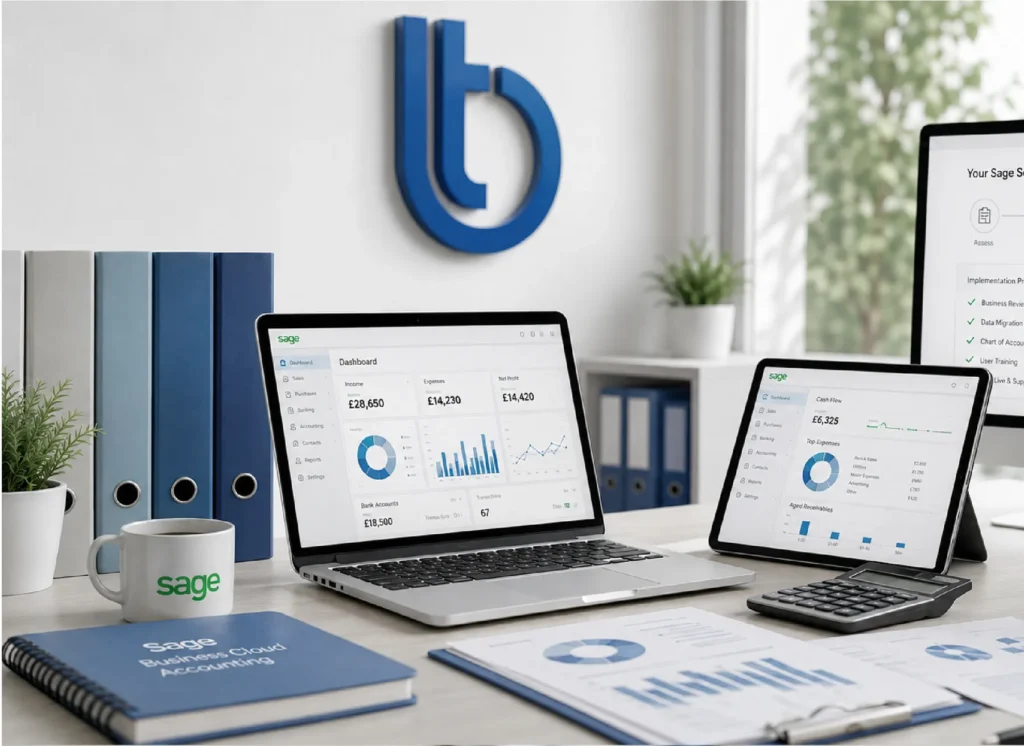
Our Sage Accounting Services
Support can be provided as a one-off project or as an ongoing bookkeeping and reporting service. Our work across Sage software UK platforms is agreed after reviewing the current setup, historical records and reporting requirements.
Sage Software Setup
Accounting periods, bank accounts, VAT settings, nominal codes and user permissions are configured around the requirements of the business.
Sage Data Migration
Existing records are reviewed and prepared before agreed data is transferred. Opening balances, customer accounts and supplier balances are checked before the new system goes live.
Sage Bookkeeping
Sales, purchases, expenses, receipts and payments are processed on an agreed schedule so the customer, supplier and nominal ledgers remain current.
VAT and MTD Configuration
VAT settings and transaction treatment are reviewed before routine processing begins. Digital records are maintained within the agreed bookkeeping scope.
Payroll Support
Payroll journals, salary payments, pension costs and outstanding liabilities can be reflected correctly within the Sage accounts.
Management Reporting
Reviewed bookkeeping data can be developed into profit and loss reports, balance sheets, departmental reports, debtor summaries and other management information.
Sage Software Setup and Financial Controls
A Sage account needs clear controls as well as accurate transaction processing. Poorly structured nominal codes, unrestricted user access and inconsistent journals can make reports unreliable and month-end work unnecessarily difficult. A controlled Sage setup may include:
Nominal ledger structure
Income, direct costs, overheads, assets and liabilities organised clearly.
Departments and cost centres
Financial activity separated where management needs to review teams, locations or business units.
User permissions
Access restricted according to each person’s responsibilities.
Posting controls
Clear treatment for journals, adjustments and recurring entries.
VAT settings
Relevant tax codes and VAT periods reviewed.
Bank accounts
Accounts configured and reconciled regularly.
Lock dates
Completed periods protected from unauthorised changes.
Reporting layouts
Reports arranged around management requirements.
Sage 50 Accounts Support
Sage 50 Accounts is commonly used by established UK businesses that need more than basic bookkeeping.
Support can cover:
- Nominal ledger review
- Customer and supplier accounts
- Bank reconciliation
- VAT records
- Stock-related bookkeeping
- Departments and cost centres
- Payroll entries
- Management reports
- Historic ledger clean-up
- Year-end bookkeeping preparation
The existing structure can be reviewed before additional nominal codes, departments or reporting categories are introduced. This helps prevent the system from becoming more complicated than the business can maintain consistently.
Sage Business Cloud Accounting Support
Sage Business Cloud Accounting can support smaller businesses that need cloud access, invoicing, bank feeds and routine bookkeeping.
Our support can include account setup, Chart of Accounts review, bank reconciliation, VAT settings, customer and supplier records, and ongoing bookkeeping.
The service is suitable where a business needs straightforward online access without the stock, departmental or reporting complexity commonly associated with larger Sage products.
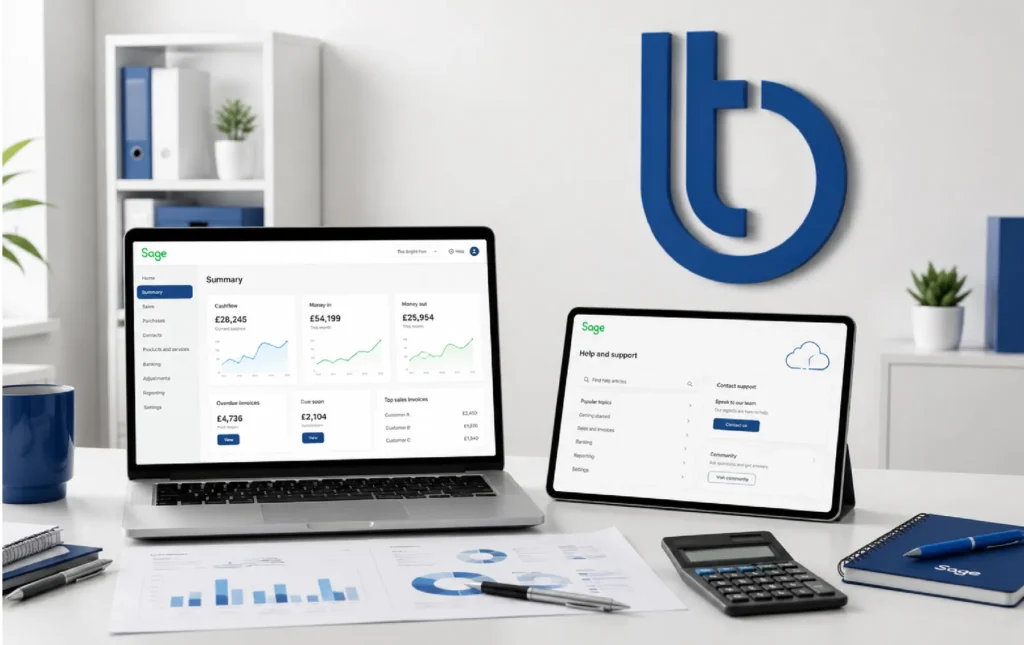
Sage Stock and Inventory Support
Stock records need to agree with purchasing, sales and accounting entries. Differences can affect gross profit, supplier balances and management reports.
Area |
Common issue |
Support required |
|---|---|---|
Stock records
|
Quantity and value differences
|
Stock and ledger review
|
Purchasing
|
Supplier commitments are unclear
|
Purchase ledger control
|
Sales
|
Customer balances are inaccurate
|
Sales ledger clean-up
|
Adjustments
|
Entries are posted inconsistently
|
Journal review
|
Cost of sales
|
Stock movements do not match reporting
|
Account and posting review
|
The agreed scope may require information from the stock system, purchase records, sales records and physical stock counts before differences can be explained or corrected.
Sage Departments and Cost Centre Reporting
Departments and cost centres can help management review different parts of the business separately. A suitable structure may support reporting by location, team, project, service line or operating division. The setup should remain practical and avoid creating more codes than the business can maintain consistently.
Top Bookkeeping Services UK can review existing department structures and improve reporting where the current setup no longer reflects how the business is managed.
Sage Bookkeeping and Management Accounts
Reliable management accounts depend on a controlled month-end routine.
Bank Reconciliation
Business bank accounts and credit cards are checked against Sage. Missing, duplicated or unexplained entries are identified before the reporting period is closed.
Sales and Purchase Ledger Review
Customer and supplier balances are reviewed for missing invoices, unallocated payments, credit notes and other unresolved entries.
Payroll and Stock Entries
Payroll journals, pension costs and stock adjustments are posted where required so the relevant costs and liabilities are reflected in the accounts.
VAT and Control Account Checks
VAT, payroll liabilities and other control accounts are reviewed for unexplained balances or incomplete postings.
Management Reporting
Profit and loss reports, balance sheets and departmental information are prepared from reviewed accounting data.
Period-End Review and Follow-Up
Management reports are reviewed for material movements, unusual balances and unresolved items. Any remaining bookkeeping queries are identified so the next reporting period begins from a controlled and up-to-date position.
Moving to Sage From Another Accounting System
Moving to Sage should improve the accounting structure rather than transfer old problems into a new platform.
Migration support can cover records from:
- Spreadsheets
- Xero
- QuickBooks
- FreeAgent
- Older Sage software
- Desktop accounting systems
- An existing Sage account requiring restructuring
- Legacy or bespoke accounting systems
Before transfer, opening balances, customer accounts, supplier accounts, VAT figures and stock records are reviewed.
Agreed data is then prepared, moved and checked before Sage becomes the main accounting record. The migration is not treated as complete until material balances and reports have been compared with the available source information.
Common Sage Accounting Problems
Sage problems often develop over several years as more users, nominal codes and manual processes are added.
Sage accounting problem |
Likely cause |
Business impact |
|---|---|---|
Nominal ledger is difficult to follow
|
Duplicate or outdated codes
|
Reports are harder to interpret
|
Customer balances remain open
|
Receipts and credit notes are not allocated
|
Debtor records are unreliable
|
Supplier balances are incorrect
|
Bills or payments are missing
|
Liabilities cannot be confirmed
|
Stock does not agree
|
Adjustments or movements are incomplete
|
Gross profit may be misstated
|
VAT control account is unclear
|
Posting or reconciliation errors
|
Additional review is required
|
Reports rely on spreadsheets
|
Department structure is unsuitable
|
Sage reporting provides limited value
|
Month-end takes too long
|
Tasks and responsibilities are unclear
|
Management information is delayed
|
Businesses searching for software Sage accounting support often face one or more of these issues. The underlying cause should be identified before entries, ledgers or historical balances are changed.
Our Sage Implementation Process
Sage implementation begins with the existing accounting process and the information the business needs from the system.
The current product, ledgers, users, VAT setup, stock records and reporting requirements are assessed.
The required work is agreed, including whether the existing Sage product remains suitable or a different version should be considered.
Nominal codes, customer records, supplier records and opening balances are reviewed before configuration or migration begins.
Accounting periods, VAT settings, departments, user roles and reporting layouts are configured.
Agreed data is transferred and key balances, ledgers and reports are checked against the available source information.
Responsibilities, bookkeeping routines, query processes and reporting arrangements are confirmed.
Sage Training and User Support
A Sage system is only effective when the people using it understand their responsibilities.
Training and handover can cover:
User roles and permissions
Sales and purchase processing
Bank reconciliation
VAT transaction coding
Stock and journal procedures
Management reports
Month-end responsibilities
Handling of bookkeeping queries
Training is shaped around the tasks each user is expected to complete rather than providing an unnecessarily broad overview of every feature.
Sage Setup and Migration Costs
The cost of Sage software UK support depends on the product, transaction volume, data quality, stock requirements and reporting complexity.
Stage |
Indicative timeframe |
|---|---|
Sage account review
|
£200–£500
|
Basic Sage Accounting setup
|
£250–£600
|
Sage 50 setup or restructure
|
£500–£1,500+
|
Sage data migration
|
£500–£2,000+
|
Historic ledger clean-up
|
£350–£1,500+
|
Ongoing Sage bookkeeping
|
£250–£1,000+ per month
|
Management reporting
|
From £250 per month
|
These prices are indicative rather than fixed quotations. The final fee will reflect the condition of the records, the number of ledgers or entities involved and the amount of historical correction required.
Sage Implementation Timeline
Sage project stage |
Typical timescale |
|---|---|
Initial Sage review
|
2–5 working days
|
Basic Sage Accounting setup
|
3–7 working days
|
Sage 50 restructure
|
1–3 weeks
|
Standard data migration
|
2–4 weeks
|
Stock and ledger review
|
Based on record condition
|
User testing and handover
|
3–10 working days
|
Ongoing bookkeeping handover
|
Usually 1–2 weeks
|
Timescales begin once access and the required accounting records have been provided.
Incomplete records, unsupported opening balances, several stock locations or complex reporting structures may extend the implementation period.
Sage Software Licence and Service Fees
Sage software licences and subscriptions are supplied and charged separately by Sage or the relevant provider.
Note: The above-mentioned services are provided via network firms if not provided directly
Our professional fees cover the agreed account review, setup, migration, ledger restructuring, bookkeeping or reporting work.
Top Bookkeeping Services UK provides a written quotation after reviewing the existing records and confirming the project scope. Additional work is not completed or charged until the requirement and cost have been explained.
Why Choose Our Sage Accounting Services?
Businesses usually need Sage support when the software is still capable of doing the job, but the accounting structure or routine processes no longer provide enough control.
Clients choose Top Bookkeeping Services UK for practical ledger reviews, careful migration, regular bookkeeping and management reporting shaped around the needs of the business.
Our Sage software UK support focuses on reliable balances, clear responsibilities and reports that can be used without extensive spreadsheet adjustment.
Make Sage Fit Your Current Business
Sage should support stronger accounting control, more reliable reporting and a manageable month-end process.
A focused review can establish whether the business needs better bookkeeping, a ledger restructure, improved reporting or a move to another Sage product.
Speak to Top Bookkeeping Services UK about Sage software UK support, migration and ongoing bookkeeping.
Sage Accounting Software FAQs
Can You Support an Existing Sage 50 Account?
Yes. The current setup, ledgers and reporting process can be reviewed and improved without automatically replacing the software.
Can You Move Records From Another System Into Sage?
Yes. Existing records can be reviewed and prepared before agreed balances and data are transferred.
Can You Help With Sage Stock and Inventory Records?
Yes. Stock-related records and their connection to purchasing, sales and ledger balances can be reviewed within the agreed scope.
Can Sage Support Departmental Reporting?
Yes. Departments and cost centres can be configured where the business needs more detailed management information.
Should a Growing Business Move From Sage 50 to Sage Intacct?
Not always. The decision depends on transaction volume, reporting complexity, multiple entities, integrations and internal finance requirements. The existing setup should be reviewed before a migration is recommended.